How does water evaporate
I tell the story to myself and try to fill in the gaps
Evaporation
Evaporation is a specific type of vaporization - the transition of a substance from the liquid phase to vapor at the liquid’s surface.
What is a vapor?
A vapor is a substance in the gas phase at a temperature lower than its critical temperature. The critical temperature is the temperature at the endpoint of the liquid-gas equilibrium curve. Above that temperature, you can't turn the gas into a liquid just by increasing pressure. So on a P-T graph, vapor is in the gaseous region at temperatures below the critical temperature.
The interesting point here is the difference between the melting curves for water and most other substances. Water is an exception to the usual rule. As pressure moves up, its melting point moves slightly lower. This is because for a typical substance, the solid is denser than the liquid. For water near its ordinary freezing point, it is the opposite, ice is less dense than liquid water. Ice floats right? Applying enough pressure to ice near its melting point can make it melt, right? That's actually really weird and unusual, applying pressure generally favors the denser phase - usually the solid!
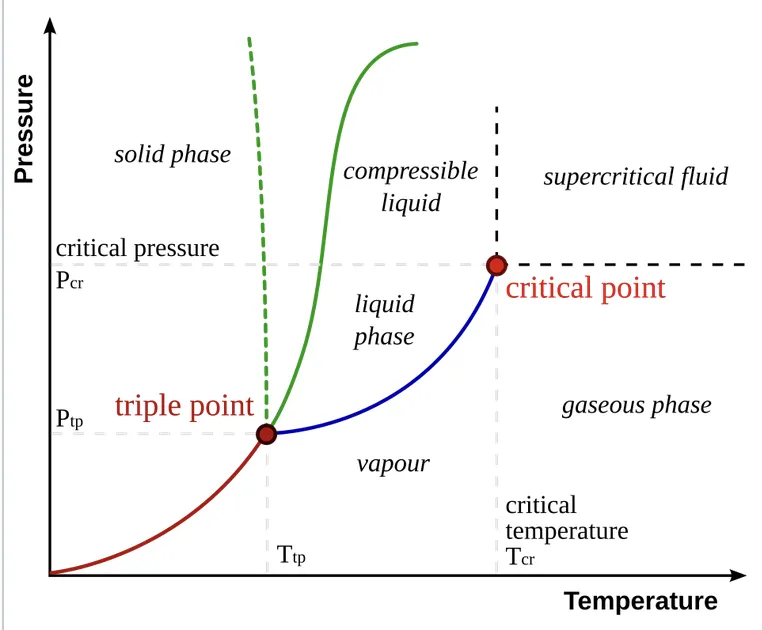
Ok a vapor is understood. So why does water turn to vapor now? Imagine the individual water molecules - held close together by attractions between them. The molecules at the top - with a direct path to air - have fewer neighboring water molecules, but still are attracted to the water molecules underneath.
Higher temperature means greater average kinetic energy of molecular motion.

Why?

Temperature is related to the energy of random microscopic motion.
The molecules don't all move at the same speed, and an individual
molecule doesn't have its own temperature.
For an ideal gas, the average translational kinetic energy - the energy of a molecule moving through space - is given by this equation:
- is the absolute temperature in kelvins.
- is the Boltzmann constant.
What is the Boltzmann constant?
Put simply, this is a constant number - exactly - that relates our macro measurements, like temperature, to microscopic energy scales.
The molecules in liquid water also have a range of kinetic energies. When these chaotic molecules near the surface have enough energy and are moving in the right direction, they can overcome the attractions holding them in the liquid and escape as water vapor. They're breaking free of attractions between molecules, not breaking apart the water molecules themselves.
So why does water evaporate at room temperature? Temperature is an average - the individual molecules have different kinetic energies. Some already have enough to escape. Heating the water just means more of them can do it.
And when those molecules leave, they take energy with them. Unless that energy gets replaced by heat coming in, the water left behind cools down. That's how sweat cools you. Your body supplies the energy for the water to evaporate.
But those water molecules can come back too, right? In humid air, more vapor molecules hit the surface and return to the liquid, so less water leaves overall. A fan carries away the water vapor building up near the surface. Fewer molecules coming back. That's why moving air helps dry things.